The Wedding at A Well.
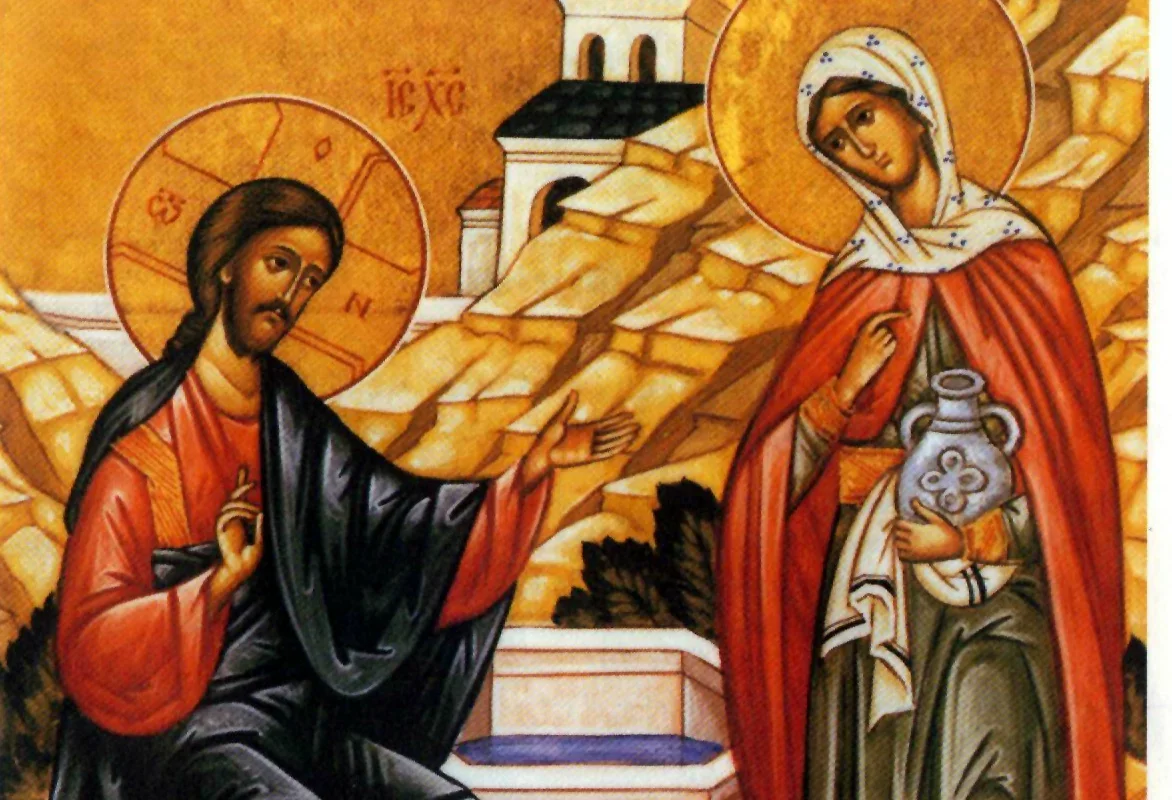
Scripture Interpreting Scripture
One of the most important principles of biblical interpretation is that Scripture interprets Scripture. The Bible is not a collection of disconnected stories but a single, unified narrative in which earlier events serve as patterns—types—that are fulfilled and deepened in later events. Typology is the method by which we trace these patterns, recognizing that God does not improvise but works according to a consistent grammar throughout redemptive history. When we come to John 4 and the encounter between Jesus and the Samaritan woman at Jacob’s well, we are not reading an isolated episode. We are reading a scene dense with echoes from Genesis, one that John has carefully composed to show us that Jesus is the true Bridegroom who has come to seek and win his Bride.
The Theopolitan tradition of interpretation takes this seriously. It insists that we read Scripture not merely for moral lessons or historical data but for the deep, layered, typological patterns that reveal Christ and his Church on every page. Typology is not just about finding pictures of Christ in the Old Testament. It is also about finding pictures of ourselves—the Church, his Bride and his Body—reflected in the women, the servants, and the people of God who populate these ancient narratives. What we discover when we read John 4 through this lens is breathtaking: the Son of God, weary from his journey, sits down at a well and woos for himself a Bride, and in doing so he reenacts and fulfills every well-scene betrothal in the history of Israel.
The History of Wells
John is meticulous in telling us where this encounter takes place. Jesus comes to “a city of Samaria called Sychar, near the plot of ground that Jacob gave to his son Joseph” and there he finds “Jacob’s well” (John 4:5–6). John is loading the scene with Old Testament memory, and every detail matters.
This land was originally purchased by Jacob from Hamor, the father of Shechem, for one hundred pieces of money (Genesis 33:19). It was here that Jacob, having returned from Paddan-Aram and having wrestled with God at Peniel, erected an altar and called it El-Elohe-Israel—“God, the God of Israel” (Genesis 33:20). The naming of that altar is significant. Jacob has received his new name, Israel, and the first thing he does upon arriving in this land is declare that Yahweh is his God. This is covenant language. This is the language of marriage and fidelity. The land itself is consecrated ground, marked by an act of worship and covenant declaration. It is at this place near this altar that God reciprocates Israel’s declaration. Once, when Jacob, now named Israel, established an altar naming it God, the God of Israel, he declared that YHWH is his God; so now Jesus declares that those like the Samaritan woman are his people (the bride). This fulfills the covenant promise, “I will be their God, and they will be my people.”
But the history of this place is not all glory. It was here that Dinah, Jacob’s daughter, was violated by Shechem, the son of Hamor (Genesis 34). The land carries the memory of a bride defiled, of an illegitimate union between the seed of promise and the Canaanite peoples. Simeon and Levi responded with treachery and violence, and Jacob rebuked them for making him “odious among the inhabitants of the land” (Genesis 34:30). The land is thus marked by both covenant faithfulness and covenant failure, by the promise of a bride and the tragedy of a bride taken wrongly.
And yet, it is precisely this land that Jacob gives to Joseph (Genesis 48:22), the beloved son, the one sold into slavery and raised to glory. It is here that Joseph’s bones are eventually buried after the Exodus (Joshua 24:32), laid to rest in the land of promise. Joseph, who is himself one of the great types of Christ in all of Scripture—rejected by his brothers, exalted among the Gentiles, and the savior of his family—has his final resting place in the very soil where Jesus now sits, weary, at the well. The ground beneath Jesus’ feet is layered with typological meaning: covenant worship, bridal tragedy, and resurrection hope.
The “Meet-cute”
In the Old Testament, wells are where brides are found. It is one of the clearest patterns in all of Scripture. When Abraham sends his servant to find a wife for Isaac, the servant goes to a well and prays that God would show him the right woman (Genesis 24:12–14). Rebekah appears, she draws water, and the servant knows she is the one. When Jacob flees to Paddan-Aram, he meets Rachel at a well (Genesis 29:1–12). When Moses flees to Midian, he meets Zipporah at a well (Exodus 2:15–21). The pattern is unmistakable. A man journeys to a foreign land, he arrives at a well, he meets a woman, and a marriage follows. Biblical scholars call this the “betrothal type-scene,” Hollywood film makers call this the “meet-cute”, and John is deliberately invoking it in chapter 4.
Jesus has traveled from Judea into Samaria—a foreign land from the Jewish perspective—and he arrives at a well. He is alone because his disciples have gone into the city to buy food (John 4:8). A woman comes out to draw water. She comes alone, at the sixth hour, not with the other women at the customary time. Everything about this scene signals that something extraordinary is about to happen. Jesus is waiting at the well, and the woman comes to him. The Bridegroom is seeking his Bride.
Jesus and Abraham’s Servant
The closest Old Testament parallel to the John 4 encounter is Genesis 24, the story of Abraham’s servant finding Rebekah at the well for Isaac. The connections between the two scenes are rich and instructive, but what makes them even more compelling is the way in which the John 4 scene escalates the pattern. In typology, fulfillment is never mere repetition—it is always greater than what came before.
In Genesis 24, Abraham sends his servant on a mission. The servant is under an oath: he must find a bride for Isaac from Abraham’s own kindred, not from the Canaanites (Genesis 24:3–4). But the servant raises a concern: “Perhaps the woman will not be willing to follow me to this land” (Genesis 24:5). Abraham’s answer is striking—if the woman will not follow, “then you will be free from this oath of mine” (Genesis 24:8). There is a genuine possibility that the mission could fail. The bride might not come.
Jesus, by contrast, asks no such question. He does not wonder whether the woman will follow. He does not hedge his commitment with an escape clause. He goes to the well with the full confidence of one who knows that his Father’s purpose will not be thwarted. Where Abraham’s servant acted in faith but with uncertainty, Jesus acts with the sovereign assurance of the Son who has come to accomplish his Father’s will. The oath between Father and Son is not contingent upon the Bride’s willingness; rather, Christ’s pursuit of his Bride is so powerful that it creates her willingness. He does not ask, “What if she will not follow?” He woos her until she does.
There are further parallels worth noting. Abraham’s servant arrives at the well and asks Rebekah for a drink of water (Genesis 24:17). Jesus likewise begins by asking the Samaritan woman for a drink (John 4:7). But here the pattern inverts. Rebekah gives the servant water and even draws water for his camels—an act of extraordinary generosity and service (Genesis 24:18–20). The Samaritan woman, however, does not give Jesus a drink. Instead, she hesitates, pointing to the social barrier between Jews and Samaritans: “How is it that you, being a Jew, ask a drink from me, a Samaritan woman?” (John 4:9).
This is where the scene takes its most beautiful turn. Rather than receiving water from the woman, Jesus offers her water. “If you knew the gift of God, and who it is who says to you, ‘Give Me a drink,’ you would have asked Him, and He would have given you living water” (John 4:10). The pattern has been reversed and elevated. In the old type, the bride serves the groom’s representative. In the fulfillment, the Bridegroom himself serves the bride. He does not come to be ministered to but to minister. He does not come to receive but to give. And what he gives is not water from a well that will leave her thirsting again but living water that will become in her “a fountain of water springing up into everlasting life” (John 4:14).
Rebekah and the Samaritan Woman
There are significant differences between Rebekah and the Samaritan woman, and these differences are themselves typologically instructive. Rebekah is a virgin, a young woman of Abraham’s kindred, pure and untouched (Genesis 24:16). The Samaritan woman is none of these things. She has had five husbands, and the man she is currently with is not her husband (John 4:18). She is a woman of Samaria—ethnically mixed, the product of the intermarriage between the remnants of the northern Israelite tribes and the foreign peoples settled in the land by the Assyrians (2 Kings 17:24–34). She is, by every measure, a woman with a past, a woman on the margins, a woman who has been looking for love and loyalty in all the wrong places.
And this is precisely the point. Typology is not only about the types of Christ; it is also about the types of the Church. The Samaritan woman is a picture of the Bride that Christ has come to seek, and the Bride that Christ seeks is not a pristine virgin who has kept herself perfectly. She is a woman who has been married to other lords, who has given herself to covenants that could not satisfy, who has drawn from wells that always left her thirsty. She is us. She is the Church, composed of Jew and Gentile alike, a people of mixed heritage who have been unfaithful and yet are pursued by a faithful Bridegroom.
The five husbands carry additional typological weight. Samaria, the former northern kingdom, was populated by people who brought their own gods with them. Second Kings 17:29–33 tells us that these peoples “made for themselves gods” even as they claimed to fear Yahweh. The five husbands can be understood as representing the five books of the Torah—the Law given to Israel as a kind of covenant husband, but which was never, in itself, able to save or satisfy. Paul makes this argument explicitly when he writes that “the letter kills, but the Spirit gives life” (2 Corinthians 3:6), and that the Law was a “guardian” or tutor that was meant to lead us to Christ (Galatians 3:24). The Torah is a true word of God, but as a husband—as the thing in which you place your ultimate hope for salvation and life—it is insufficient. It cannot give what only the living Word can give.
And so the woman stands at the well with five failed marriages behind her and a current arrangement that is not even a real marriage. She is a picture of a person who has tried everything and found nothing that lasts. Into this situation steps Jesus—not as husband number six but as the true Husband, the one whom all the previous covenants were pointing toward. He is the Word made flesh (John 1:14), the one who does not merely give a law but gives himself. He is the Bridegroom who can do what the Torah could never do: not merely command obedience but transform the heart, not merely prescribe life but impart it.
Quenching a thirsty Bride.
One of the most quietly powerful details in the passage is what happens after the woman receives Jesus’ word. John tells us, “The woman then left her waterpot, went her way into the city, and said to the men, ‘Come, see a Man who told me all things that I ever did. Could this be the Christ?’” (John 4:28–29). She leaves her waterpot. This small detail is a sign of what has happened inside her. She came to the well to draw water because she was physically and, as the narrative reveals, spiritually thirsty. But now she leaves the instrument of her old thirst behind. She has found the living water. She no longer needs what the well can offer because she has received what only Christ can give and has become a well herself.
This mirrors what Rebekah does in Genesis 24, though in a different key. When Rebekah learns that Abraham’s servant has come seeking a bride for Isaac, she runs to tell her family (Genesis 24:28). The Samaritan woman likewise runs back to her city to tell everyone what she has found. Rebekah’s report leads to a negotiation and a willing departure. The Samaritan woman’s report leads to something even greater—the people of Sychar come out to see Jesus for themselves, and many believe (John 4:39–42). The bride does not merely follow; she becomes a witness, an evangelist, a herald. She brings others to the Bridegroom.
This is what the Church does. This is what the Bride of Christ is called to do. Having received the living water, she does not keep it to herself. She goes out into the world and says, “Come, see a Man.” The water that Christ gives becomes in her a spring, a fountain, an overflowing source that blesses everyone around her. She is no longer a woman defined by her failed relationships and her empty water pot. She is a woman defined by the Bridegroom who sought her, found her, and filled her.
Satisfying a Hungry Groom.
What is perhaps most striking in the entire passage is what happens to Jesus himself. John tells us at the beginning of the scene that Jesus was “wearied from His journey” and sat down by the well (John 4:6). He was tired. He was hungry—that is why the disciples went into the city to buy food. He was thirsty—that is why he asked the woman for a drink. Jesus comes to this well in genuine human need, emptied and exhausted from his travels.
But when the disciples return with food, something has changed. They urge him, “Rabbi, eat” (John 4:31). And Jesus says something remarkable: “I have food to eat of which you do not know” (John 4:32). The disciples, confused as always by his metaphors, wonder if someone has brought him something to eat. But Jesus explains: “My food is to do the will of Him who sent Me, and to finish His work” (John 4:34).
What has happened between the time the disciples left and the time they returned? Jesus has met his Bride. He has wooed her. He has offered her living water, and she has received it. She has left her water pot and gone to proclaim him. And in that encounter—in the willing response of the Bride to the Bridegroom—Jesus himself is satisfied. He is no longer weary. He is no longer hungry. The Bride’s response to his love has become his nourishment.
This is not merely poetic language. Paul tells us in Ephesians that the Church is the “fullness of Him who fills all in all” (Ephesians 1:23). Christ fills the Church, yes—but in a mystery that should take our breath away, the Church also fills Christ. He is the head, and she is his body, and a head without a body is incomplete. The Bridegroom is not fully satisfied until the Bride responds to his love. This is the marital covenant in its deepest reality: two becoming one, each finding their completion in the other. Jesus offers water, and the woman receives it. The woman responds in faith, and Jesus is fed. Both are satisfied. Both are filled. The well scene in John 4 is a communion meal—a picture of the covenant fellowship between Christ and his Church in which he gives everything and, in receiving her love in return, finds the joy set before him for which he endured the cross (Hebrews 12:2).
Christ and The Church.
When we read John 4 typologically, we see far more than a historical conversation between a Jewish rabbi and a Samaritan woman. We see the Bridegroom of Israel arriving at the ancient well of covenant promise, sitting down on ground soaked with the memory of Jacob’s altar, Dinah’s tragedy, and Joseph’s bones. We see him waiting for a woman who has been failed by every husband she has ever had, and we watch him offer her something none of them could: water that will never run dry.
We see the old patterns of Genesis 24 fulfilled and surpassed. Where Abraham’s servant wondered if the woman would follow, Jesus went with confidence. Where Rebekah gave water to the servant, the Samaritan woman receives living water from the Master himself. Where the old bride was a virgin of pure lineage, the new Bride is a woman of mixed heritage and broken covenants—and that is precisely the point. Christ did not come for the righteous but for sinners. He did not come for a bride who had kept herself perfectly but for one who desperately needed to be made new.
And so the Samaritan woman is a type of the Church—of you and of me. We are the ones who have had five husbands who could not save us. We are the ones who came to the well with an empty pot and an emptier soul. We are the ones whom Christ met in our weariness and offered us something the world could never give. And when we received it—when we left our water pots behind and ran to tell others that we had found the Christ—we discovered that we were not the only ones made full. The Bridegroom himself was satisfied. Our faith is his food. Our worship is his joy. Our response to his love is the completion of his work.
This reading opens the text into a living world where every well, every bride, every pot of water and piece of bread points to the great reality at the center of all things: Christ and his Church, Bridegroom and Bride, the covenant of love that began before the foundation of the world and will not be complete until the wedding supper of the Lamb (Revelation 19:9).
Peace be with you,
Pastor Bruce